Ask for a quote
Pool coaching
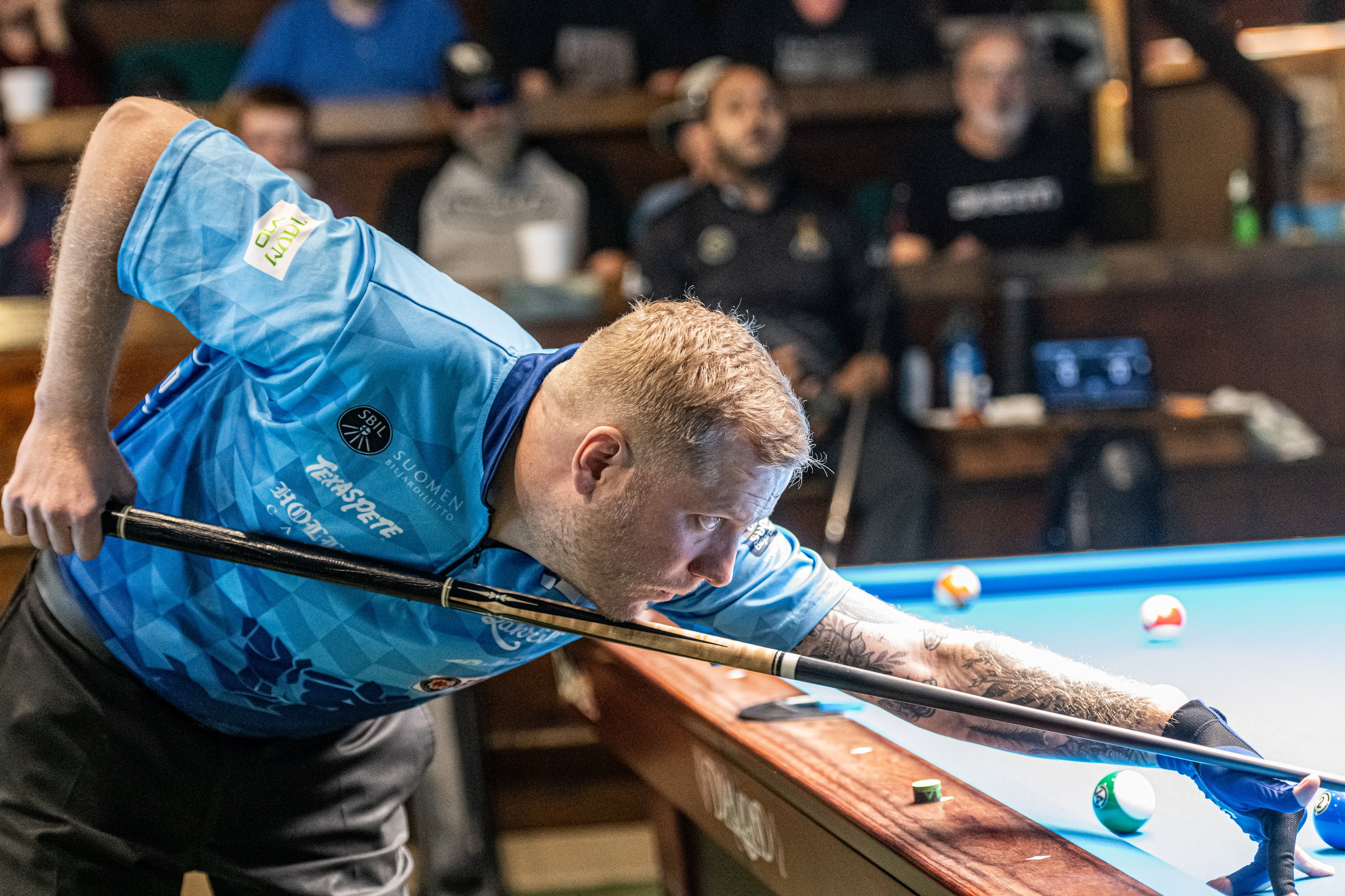
I coach in Helsinki at the same table I compete on. No ready-made package: first we find where your game leaks. Then we rebuild it and repeat it until the fix holds under pressure too.
Regularly in the Helsinki region, elsewhere in Finland and abroad by agreement.
- 01
Private 1-to-1
One player and my full attention. We go through stance, stroke and cue-ball control, but also the decisions: what you play when the easy pattern runs out. The content follows what your match shows, not a lesson plan written in advance.
- 02
Small group 2–4
One shared language for the whole group and more reps per table. It suits a group of friends or club players who want the same correction at the same time and can keep coaching each other afterwards.
- 03
Fundamentals
Grip, stance, aim and cue-ball control in an order that actually works. We start from zero without tournament jargon, and after the first session you have a routine you can practise alone.
- 04
House calls and travel
In the Helsinki region I can come to your tables, and elsewhere in Finland by agreement. Longer trips and travel abroad can be arranged when the schedule and the whole package make sense.
- 05
Video analysis
Film your shots on a phone and send the clips online. You get specific corrections and drills in priority order: not a general lecture, but the work that raises your level fastest.
Jani answers
What coaching actually is
In coaching I pass on what I have already paid for in time, travel and mistakes. Fundamentals first, then the game, and the head comes with it. The sport is serious, the mood is not.
01Why a professional?
You can learn by playing. That way you also pick up ten bad habits that feel like yours, because you have repeated them thousands of times.
In pool the gaps are made in small things. Stance, grip, tempo, how the stroke feels when it is right. If nobody watches from the side, you correct the wrong thing. I have seen it in my own game and in the hall: a player puts in the hours, and the same miss keeps coming back, because the foundation is not there.
Professional coaching is not a trick school. It is someone who has put balls in for years showing you where your game actually leaks. You save time. And time is the expensive part of this sport.
02What do you leave with?
First we look at where you start. One person has years of play, another is holding a cue for the first time. The same programme does not work for both.
We go through the basics: grip, stance, aim, the rhythm of the stroke. Then drills you can take into your own practice. The point is not that I stand next to you and you look good for an hour. The point is that next time you know what to practise, and why.
If you come as a group, we learn the rules, the etiquette and enough technique that the game starts to move. Then we play. If you come alone to raise your level, we go closer: where the cue ball stops, why it stopped there, what the options were, and how the head felt when the decision had to be made.
One hour does not make a champion. One hour can still cut the loop where you practise the wrong thing hard.
03Who is this for?
Not only tournament players.
Pool bends to a lot of jobs. Someone wants to beat a colleague at the Christmas party. Someone wants the cue in their hand not to feel embarrassing. Someone wants national championship level. Someone just wants a hobby where the head can be quiet.
All of those benefit from the fundamentals being in place. For a competitor, coaching is often the mirror you do not get from your own group. For a hobby player it is the shortcut to the game feeling like a game, not like poking balls around.
And to company groups I say it straight: we do not sit there in silence. The sport is serious, the mood is not.
04Isn't a club player enough?
There is always someone in the hall who “can give a tip”. That someone usually teaches what works for them.
At the top there are nutritionists, physios, psychologists and PTs. The gaps are made off the table too. Even the old-school players have worked out that the rest of life has to be in order if you want to last in this.
Same logic for a hobby player. An experienced player sees that the ball did not go in. A professional sees why it did not go in, and can say it so that you can fix it yourself. And it is not only technique. It is what you do when the game is not running. I have seen enough of that, in my own mirror.
05What do the tour years teach?
That this is not only a cue and a ball.
I have played 8-ball, 9-ball, 10-ball and straight pool for a living. The year is hard: dozens of events, a lot of days abroad. On a tournament trip the focus is the game. Friends think I am seeing the world. The reality is hotel porridge and the same routine in a different city.
In 2018 the results were poor and the money was not coming. I ended up with a psychologist. That period opened locks. It may sound heavy for a website, but it is true: in this sport the head decides as much as the hand.
So in a session we do not only talk about where the ball is struck. We also talk about what happens when you miss an easy one and still have to play the next.
The brightest crown, a world title, is still out there for me. Same attitude for the person I coach: a short goal, a long goal, then the work. No win without sacrifice. That does not mean a hobby player has to live like a professional. It means progress takes a decision.
06What this is not?
It is not a magic trick, and it is not “three tips that always win”.
It is also not me playing it for you. I can show, explain and correct. You have to hit the ball.
And it is not a verdict. I have seen enough of what it feels like when the game is not running. You are allowed to miss in the session. A miss is data. That is where we start.
07How to prepare?
Bring your own cue if you have one. If not, we manage with the hall's.
Think of one thing in advance: what you want to feel better after the hour. That the ball leaves cleaner. That you know the rules. That your group gets a shared game. That your break is not a lottery.
If you come as a tournament player, tell me which game you play and where it last jammed. The more precisely you can say that, the less time we spend guessing.
08Groups, companies, schools
The fundamentals, the rules, the start of a stroke, and a match.
I have seen enough players at different levels that the basic notes go in quickly. In group sessions the starting point is: learn, try, play. For a company it is a day out that is not a fake team-building exercise. For school groups it is a sport where you can do well without being the biggest or the fastest.
Fun is not the opposite of learning. It is the reason people come back to the table.
09How do you know it is working?
When you no longer ask why that missed, but you already know before the stroke what the risk was.
When practice is no longer “let's hit a few balls”, but you have one or two things you repeat on purpose.
And for a tournament player, when a bad day does not wreck the whole set. The game is allowed to wobble. The routine is not.
Ask for a quote
Get in touch